
Article republished with permission from Water Strategies LLC. Article was originally published in the June 2025 edition (Volume 16, Issue 6) of the Irrigation Leader magazine, a monthly publication sharing real-world insights from irrigation professionals across the western U.S. and beyond.
Australia-based SWAN Systems has developed a cloud-based software platform compatible with existing hardware that’s an all-in-one tool for water, nutrient, and irrigation management. A 7‑day predictive irrigation plan takes the time and guesswork out of irrigation planning. In this interview, Tim Hyde, SWAN’s CEO, and Shannon Rinkenberger, the company’s California-based key account manager, tell Irrigation Leader how the software can help farmers increase their water efficiency and produce better yields. They also discuss the software’s ability to help California growers manage their water use and reporting requirements imposed by the Sustainable Groundwater Management Act (SGMA).
Irrigation Leader: Would each of you tell us about your background and how you came to be in your current position?
Tim Hyde: I’m the CEO and one of three founders of SWAN Systems. My background is in horticulture as both a grower and a consultant. The company started in Australia, and we work in 9 countries now. Originally, we consulted with growers and managed irrigation in remote and challenging environments. Growers and government alike were interested in our water optimizing approach to irrigation management, but it wasn’t scalable in its original form. That’s why we decided to convert it into software and launched SWAN in 2016.
Shannon Rinkenberger: I’m from a multigenerational farming family in California’s Central Valley. I grew up walking orchards with my great-grandfather, talking about water, fertilizer, pests, and pruning. I earned an agricultural business degree from California State University, Fresno, and worked in ag lending and land use before joining SWAN, to which I was introduced through a mutual connection, in 2023. Agriculture is deeply personal to me, and I’m passionate about helping farmers manage their water more effectively.
Irrigation Leader: Please introduce SWAN Systems.
Shannon Rinkenberger: SWAN Systems is a software solution developed to help growers and agribusiness water managers optimize irrigation and nutrient management through data-driven decision making. Our mission is to maximize water efficiency, improve crop yields, and support sustainable agriculture by providing actionable insights using data from farm infrastructure, weather forecasts, and satellite imagery.
We work with agricultural enterprises, municipalities, and corporate sustainability programs. The system was originally built around a 7‑day predictive irrigation plan and has grown to include nutrient budgeting, a crop health module (using satellite imagery), reporting tools, and decision support features for a wide range of users. We believe that better water management starts with better data.
Tim Hyde: When you farm using water and nutrients sustainably and precisely, you get improvements in yield and quality. Our system helps farmers be more profitable by reducing the cost of the inputs and improving the quality of the outputs.
Irrigation Leader: Please tell us more about how the system works.
Tim Hyde: Our software is a complete decision-support tool that includes irrigation scheduling, water management, nutrient management, and detailed reporting for compliance and planning.
Shannon Rinkenberger: The system is designed to be user friendly and intuitive. SWAN Systems provides quick insight into the information that our growers need. It is a cloud-based platform that is accessible via a desktop or a mobile app. The dashboard shows water budgets, application history, forecasted irrigation schedules, weather, and satellite imagery. It also includes maps, graphs, and reports that make decision making easy. Every user is paired with a customer success manager to support implementation and ongoing use.
The predictive model is based on data from a range of sources, including weather stations, soil moisture history, and satellite imagery. We also factor in soil types and root depth. We can generate reports on water use efficiency that show what was grown on an acre and the cost associated with each acre-foot of water applied. SWAN can also help growers with nutrient tracking. We don’t make fertilizer recommendations; instead, we help growers monitor nutrient budgets and actual
usage. Our users get insight into how their resources are being applied and the outcomes they are achieving.
The platform is highly configurable. It works with a variety of irrigation systems, soil types, and cropping processes. We are hardware agnostic and currently integrate with over 100 hardware providers. SWAN doesn’t tell a grower what hardware to use — it works with what they already have.
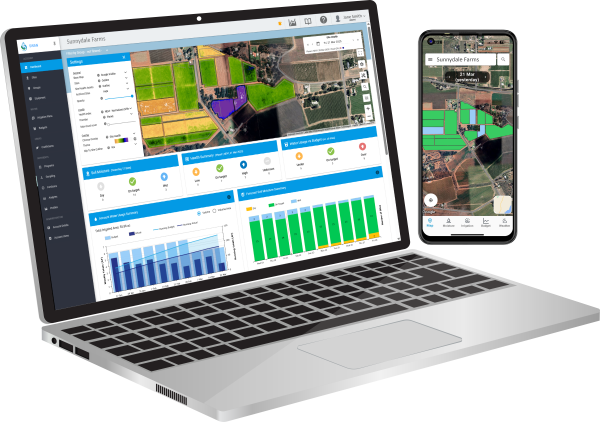
SWAN Systems’ solution can be used on a laptop or a smartphone.
Irrigation Leader: Would you talk about the importance of water stewardship and the implications of SGMA?
Shannon Rinkenberger: SGMA, a California law passed in 2014, was designed to address the long-term sustainability of groundwater resources. The law’s goal is to ensure there is enough groundwater for the future – but for growers, it also means water has become liquid gold. Without water, farming simply isn’t possible. Given California’s heavy reliance on groundwater, effective water stewardship is critical.
SGMA has had a wide range of consequences, from mandatory documentation to potential limits on water usage. It has put in place more than 260 groundwater sustainability agencies (GSAs) that manage more than 500 aquifers. Each must have a groundwater sustainability plan (GSP), and growers are responsible for understanding their obligations under those plans. Many are managing multiple GSPs at once.
Some growers have been practicing efficient water management for years, while others are facing the need to adapt quickly to new documentation and efficiency standards. SGMA has forced many to reassess their entire water strategies – especially those who are facing reductions in groundwater availability. This can mean fallowing land, shifting to less-water-intensive crops, or making tough decisions about which fields receive available water. In some cases, the cost of staying in production under new restrictions may lead farmers to temporarily pause operations.
These decisions often come with significant financial implications, especially when they involve investing in more efficient irrigation infrastructure or technologies. For those who exceed their water allocations, penalties and increased water costs can further strain operations. Many growers are still learning the details of their GSA or GSP obligations.
That’s where SWAN comes in. Our platform helps growers manage their GSPs to meet SGMA compliance requirements. SWAN’s Water Supply Manager tracks incoming water, whether from wells, surface allocations, or reservoirs, and compares planned, budgeted, and used volumes. Combining that with our System Suggested Irrigation feature, growers can proactively plan for what’s ahead and use their resources more efficiently.
Irrigation Leader: Where are you currently marketing your product, and where do you hope to expand?
Tim Hyde: We’re currently active in Australia; Chile; New Zealand; Peru; Zimbabwe; and across the western United States, including in Arizona, California, and Washington. We’ve recently gained some exposure to the French, Spanish, and Turkish markets in the Mediterranean. We’ll work on getting some traction in those markets before we think about expanding. After that, the next obvious market is the American Midwest and then the Mississippi basin.
Shannon Rinkenberger: California is the largest agricultural market in the United States, so it’s a critical region for us. Establishing a strong foothold here is key before we move into other U.S. regions.
Irrigation Leader: Would you tell us about some of your successes?
Tim Hyde: In the Colorado River basin, we’re seeing excellent results using SWAN to provide decision support for Rubicon Water’s FarmConnect system. Growers have achieved 20–30 percent reductions in water use and increases in alfalfa yields. In Washington, our involvement in the Smart Orchard project has delivered improved packout rates, reduced disease pressure, and water savings of over 50 percent compared to conventional scheduling methods. In Australia, we partnered with the wine grape industry on a trial that compared SWAN with several in-field technologies. The block using SWAN showed significant improvements in both yield and fruit quality. We also work with a large table grape grower in California that has reported notable improvements in water use efficiency and fruit quality. Getting water right often means getting quality and production right, contributing to a more viable, sustainable farming enterprise.
Shannon Rinkenberger: Our customers also report big savings. SWAN replaces spreadsheets and guesswork with a clear picture of what needs to be done, saving growers time and effort in irrigation planning.
Irrigation Leader: What is your vision for the future?
Tim Hyde: Our vision for the future is to democratize access to decision-support technology for commercial irrigators and water managers. We have built SWAN to be robust but simple to use, and we want to bring a high level of precision and support to irrigators everywhere, lowering the barriers to adoption by making advanced irrigation tools accessible, practical, and effective.