Saving water and growing profits: Lessons from a Washington Cosmic Crisp orchard trial.
Smart irrigation technology helped a Mattawa Washington orchard achieve 22% higher gross profits and 52% water savings in its first Cosmic Crisp apple harvest. By combining data-driven scheduling with automation, the orchard improved fruit quality, reduced defects, and maximized returns.
Introduction
SWAN Systems was invited by Washington State University (WSU) to participate in their Smart Orchard Testbed and Demonstration site – a fourth leaf Cosmic Crisp orchard being harvested for the first time in 2024. Funded by the Washington Tree Fruit Research Commission (WTFRC), this initiative aimed at evaluating and validating emerging agricultural technologies in commercial orchard settings.
Located in Mattawa, WA, this Cosmic Crisp apple orchard serves as a model for modern orchards in Washington, employing advanced techniques such as tall spindle training, drip irrigation, and heat stress mitigation systems. Two sites were setup to be compared, block 1 being the testbed site and block 2 was managed normally by the farm management company.
The overarching goal of the project is to facilitate meaningful adoption of innovative technologies to improve efficiency and productivity in Washington apple orchards.
SWAN Systems’ Involvement
SWAN Systems participated in the Smart Orchard project from July 1, 2024, to October 31, 2024, managing irrigation in collaboration with WSU, Northwest Farm Management, LLC (NWFM), and WiseConn. The team employed SWAN’s System Suggested Irrigation tool to develop and execute weekly irrigation schedules on block 1, which was integrated with WiseConn’s DropControl irrigation automation system. This collaborative approach created a closed-loop system of data collection, analysis, and execution (Figure 1), optimizing water use and ensuring precise irrigation management.
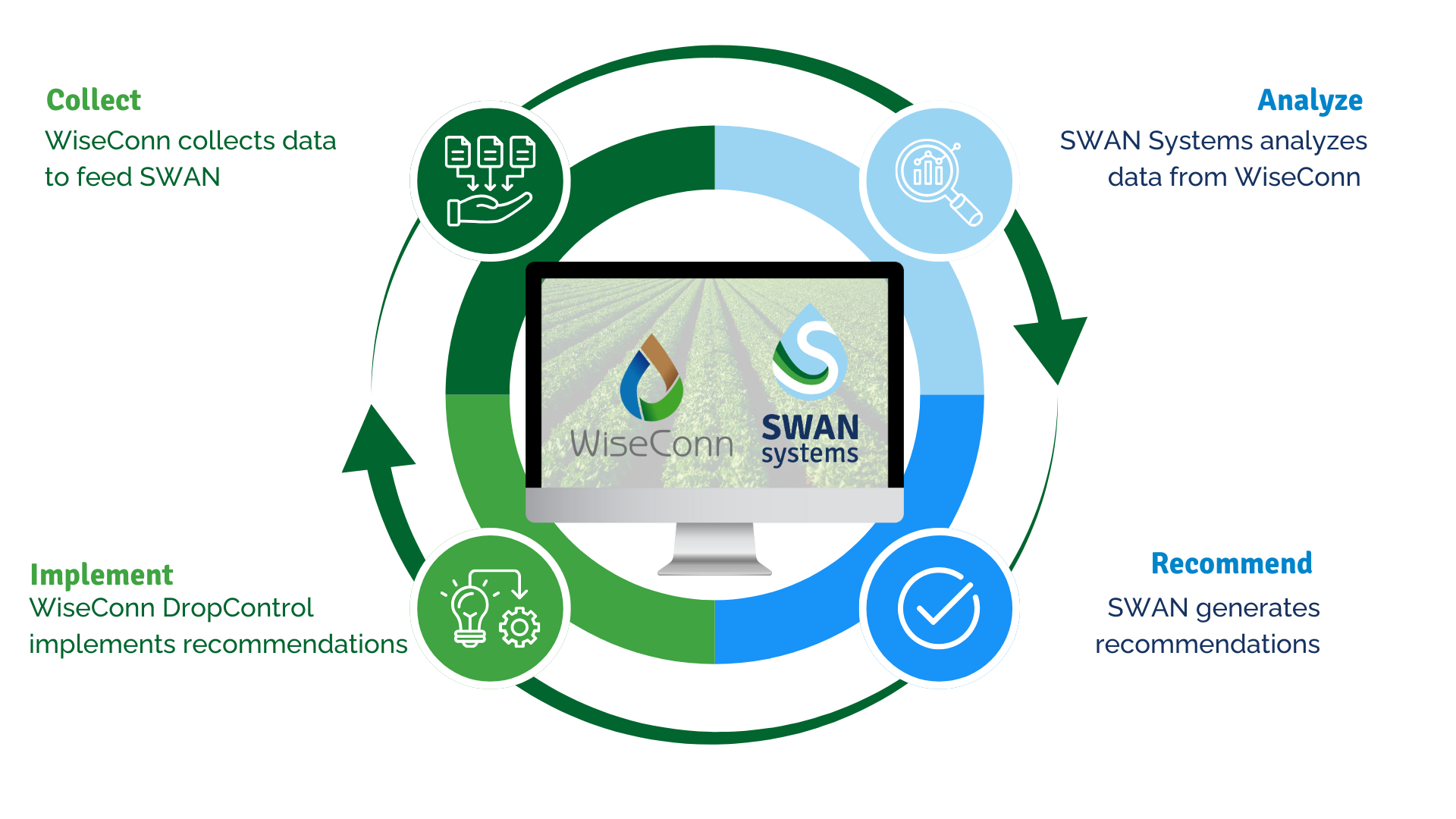
Figure 1: How SWAN Systems and WiseConn work together – Connect, Analyse, Recommend, and Implement.
Methodology
Irrigation Planning and Execution: Weekly irrigation schedules, created by SWAN’s System Suggested Irrigation, were developed and then implemented by SWAN’s Talk Back communication to the irrigation automation technology supplied by WiseConn.
Custom Crop Coefficients: Baseline crop coefficients were recommended by WSU, and adjustments were tailored to the unique conditions of the orchard for 2024.
Data Integration: Additional data were captured through soil probe data, Planet satellite imaging, and the Mattawa WSU weather station.
Optimization and Automation: Daily data analysis ensured soil moisture remained within the ideal range, reducing drainage losses and over-irrigation.
Key Results
The SWAN model delivered substantial water savings and improvements in fruit quality and pack-out rates. Block 1, which used SWAN’s irrigation scheduling, recorded significantly lower rates of necrosis, green spot, and overall fruit defects compared to the grower-managed block (Table 1).
Water Savings: Using SWAN’s climatic model, block 1 resulted in a 52.4% reduction of water use when compared to the grower developed irrigation scheduling in block 2. Total water usage was 0.69 AF/ac in block 1, while block 2 used 1.32 AF/ac.
Fruit Quality: Yield and fruit quality were also assessed.
Table 1: Fruit defect on the 2024 WA 38 (Cosmic Crisp) fruit harvest, by site. (Source: 2025 Technology Research Review).
| Category | Necrosis % | Green spot % | Defect % |
|---|---|---|---|
| Block 1 | 4 | 6 | 16 |
| Block 2 | 13 | 23 | 45 |
| P value | 0.037 | 0.002 | <0.001 |
Block 1 achieved 21% higher production after accounting for defect and size, despite a lower total yield (15.5 tons at block 1 versus 19.5 tons at block 2). Block 1 packed out 13.07 tons, compared to 10.74 tons for block 2.
Based on the 2024 industry price of $1,800 per ton for Cosmic Crisp apples, this equated to an additional $4,201.20 per acre – a 22% increase in gross profit.
Return on Investment
The return on investment (ROI) for this operation was calculated at 64:1, based on actual yield, water usage, and 2024 industry pricing data.
The calculation includes SWAN Systems’ annual software subscription and a 15-year amortization period for WiseConn hardware and automation. Costs factored into the ROI include water, pumping and delivery, fertilizer, marketable yield, pricing, and management time savings — all of which are directly related to water management.
These figures are based on actual data from the 2024 growing season and industry benchmarks.
A 64:1 ROI in the first season shows the financial power of smarter irrigation.
Conclusion
The Smart Orchard project demonstrated the strong potential of data-driven, automated irrigation. SWAN Systems’ water management solution, in collaboration with WiseConn’s technology, reduced water use, improved fruit quality, increased pack-out rates, and delivered a strong first-year ROI. This successful implementation highlights the value of integrating smart technologies into modern agriculture – offering a scalable model for enhancing water use efficiency and productivity in commercial orchards.
Thank you to our partners WSU, WTFRC, Innov8, & WiseConn.
Smart Apple Orchard Principal Investigators: Lav Khot, Bernardita Sallato, Steve Mantle, R. Troy Peters, Anantharaman Kalyanaraman